
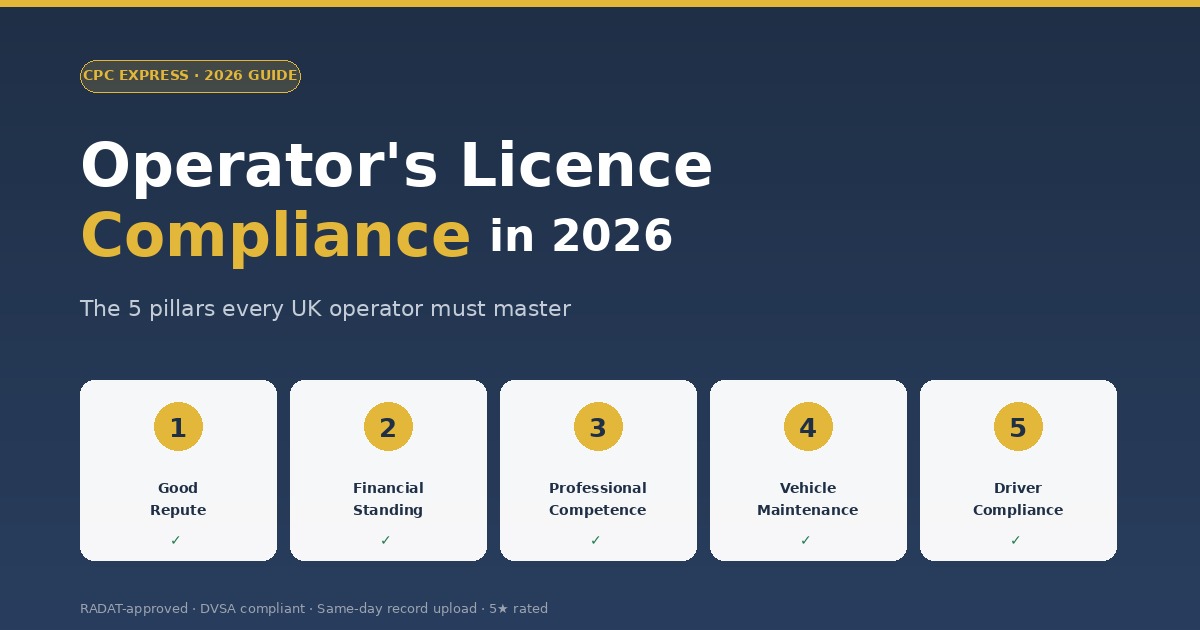
Operator's Licence compliance means meeting the legal duties that come with running goods vehicles over 3.5 tonnes. The five core pillars are: good repute, financial standing, professional competence, vehicle maintenance, and driver compliance (including Driver CPC). Failure can lead to fines, vehicle prohibitions, or revocation by the Traffic Commissioner.
Holding a goods vehicle Operator's Licence is one of the biggest responsibilities in UK transport. Operator's Licence compliance isn't a one-off task — it's a continuous obligation that affects everything from how you maintain vehicles to how you employ drivers.
This guide breaks down the five compliance pillars, how the DVSA's OCRS traffic light system rates you, the most common reasons operators fall foul of the Traffic Commissioner, and how to build a system that keeps your O-licence safe for the long term.
What Is Operator's Licence Compliance?
Every UK business operating goods vehicles over 3.5 tonnes (or carrying passengers for hire) needs an Operator's Licence (O-licence) issued by the Office of the Traffic Commissioner. The licence comes with a set of legal "undertakings" — promises you make to operate safely and legally.
Compliance means meeting those undertakings every day, not just at audit time. The Traffic Commissioner has the power to call you to a Public Inquiry, restrict your licence, or revoke it entirely if you fail. For more on the commitments themselves, read our guide on operator licence undertakings explained.
The Five Pillars of Operator's Licence Compliance
The Traffic Commissioner assesses operators across five core areas:
1Good Repute
Demonstrating integrity in business dealings — no convictions, no false statements to authorities, no failure to pay drivers or suppliers.
2Financial Standing
Holding sufficient capital to operate safely. The threshold is set annually by DVSA and the Traffic Commissioner.
3Professional Competence
A nominated Transport Manager with valid CPC must oversee operations. Wider operations staff also benefit from Operator Licence Awareness Training (OLAT) to understand their duties.
4Vehicle Maintenance
Vehicles must undergo regular safety inspections. Records, defect reports, and tachograph data must be kept and audit-ready.
5Driver Compliance
All drivers must hold valid licences and Driver CPC, follow drivers' hours rules, and use tachographs correctly.
+Operating Centre
Your declared operating centre must have sufficient space and not cause environmental nuisance to neighbours.
OCRS: The DVSA Traffic Light System Explained
The Operator Compliance Risk Score (OCRS) is the DVSA's traffic light system that rates every UK operator's compliance risk across a rolling 3-year period. Operators are banded Green, Amber, Red, Grey, or Blue. Red operators face frequent roadside stops and depot inspections; Green operators are largely left alone.
OCRS scores are calculated from two data streams — roadworthiness (annual tests, defects, prohibitions) and traffic (drivers' hours offences, tachograph infringements, loading issues). DVSA re-scores operators every day across a rolling 3-year window, so old issues drop off over time and good behaviour is rewarded.
OCRS Bands at a Glance
| Band | Risk Level | What It Means |
|---|---|---|
| Green | Low | Minimal roadside stops or depot visits. Many green operators go years without a DVSA inspection. |
| Amber | Medium | Periodic checks. Usually one or two depot visits per year, more frequent roadside attention. |
| Red | High | Priority enforcement target. Frequent stops, multiple unannounced depot inspections, ANPR camera flags. |
| Grey | Unknown | No DVSA encounters in the past 3 years. Common for new or very small operators. |
| Blue | Earned Recognition | Operators accredited under DVSA's Earned Recognition scheme, the kitemark for fully audited compliance systems. |
You can check your OCRS score on GOV.UK by logging into the Manage Commercial Vehicle Compliance service. The single fastest route to drop from Green into Amber — or Amber into Red — is unmanaged Driver CPC failures.
Most Common Operator's Licence Compliance Failures
The Traffic Commissioner publishes Public Inquiry decisions every month. The most frequently cited compliance failures are:
- Drivers without valid CPC — operators using drivers whose Driver CPC has expired
- Missed safety inspections — vehicles overdue for their scheduled maintenance check
- Tachograph infringements — drivers exceeding hours limits without action from the operator
- Poor record-keeping — missing maintenance reports, defect records, or driver licence checks
- Financial standing gaps — insufficient capital evidenced at a regulatory check
- Operating centre issues — using locations not declared on the licence, or causing environmental complaints
Most failures cluster around drivers — making Driver CPC compliance the single most cost-effective area to focus on. Read our Driver CPC requirements guide for what every operator needs to verify.
An Operator's Licence Compliance Checklist for 2026
Use this annual checklist to stay ahead:
- Verify every driver's Driver Qualification Card (DQC) expiry date
- Check Driver CPC training hours quarterly via GOV.UK
- Schedule and record vehicle safety inspections at the correct intervals
- Review tachograph data weekly to catch infringements early
- Maintain defect reporting books and act on every report
- Keep financial standing records (bank statements, accounts) ready for audit
- Confirm Transport Manager's CPC qualification is current
- Ensure non-driving operations staff have completed Operator Licence Awareness Training (OLAT)
- Verify operating centre declarations are up to date
- Update the Traffic Commissioner of any material changes within 28 days
- Run an internal audit at least once a year — before DVSA does it for you
Why Driver CPC Is Central to Operator's Licence Compliance
The single most preventable cause of O-licence problems is drivers operating without valid CPC. Each failure can trigger:
- A £1,000 fine for the driver
- A separate £1,000 fine for the operator
- A Traffic Commissioner referral if it suggests systemic failure
- A drop in OCRS band — leading to more frequent stops
- Possible reputational damage with insurers and customers
For context on the legal risks, read our guide on driving without Driver CPC. The fix is simple: build a system that checks every driver's CPC status before every shift.
How to Build a Driver CPC Compliance System
For multi-driver fleets, here's a practical compliance system:
- Central spreadsheet tracking every driver, DQC expiry date, and hours completed
- Quarterly review — check GOV.UK records for every driver every 3 months
- Booking schedule — book any drivers who are within 12 months of expiry immediately
- Pre-shift checks — verify DQC validity before allowing a driver out
- Train operations staff alongside drivers — book your Transport Manager, supervisors and office team onto OLAT so the whole operation understands the rules they're enforcing
- Provider relationship — use a single approved provider with same-day uploads, such as CPC Express, the RADAT-approved Driver CPC training provider operating under NLTC consortium AC00591
- Driver communication — make CPC compliance everyone's responsibility, not just the Transport Manager's
This system prevents 99% of CPC-related compliance failures.
What Happens If Operator's Licence Compliance Slips?
The Traffic Commissioner has a graduated response to compliance failures:
- Warning letter — for minor or first-time issues
- Public Inquiry — for significant or repeated failures
- Restrictions — reducing your authorised vehicles or limiting where you can operate
- Revocation — losing your O-licence entirely (often ending the business)
- Disqualification — barring directors from holding any future O-licence
Most operators who appear at Public Inquiry have made the same mistake: assuming "it'll be fine" when warning signs were obvious. Compliance is cheaper than enforcement.
Frequently Asked Questions
Who oversees Operator's Licence compliance in the UK?
The Office of the Traffic Commissioner issues and oversees O-licences. The DVSA conducts roadside checks and audits on behalf of the Traffic Commissioner.
Do I need an O-licence for vehicles under 3.5 tonnes?
Generally no — though there are exceptions for passenger transport. Goods vehicles up to 3.5 tonnes used for own-account work usually don't need an O-licence. Always confirm with the Traffic Commissioner if uncertain.
What's the difference between O-licence undertakings and compliance?
Undertakings are the promises you make when granted an O-licence. Compliance is the act of keeping those promises every day. Read our guide on operator licence undertakings explained.
What training do operations and office staff need?
Non-driving operations staff — Transport Managers, traffic office, planners, supervisors, compliance officers — should complete Operator Licence Awareness Training (OLAT). It's a 7-hour course covering the legislation, undertakings, and compliance obligations that govern UK transport operations, and counts as 7 hours toward Driver CPC for any attendee who also holds a vocational licence.
How often does DVSA audit operators?
It depends on your OCRS band. Green operators may go years without an audit. Red operators can be inspected multiple times a year and stopped at the roadside far more often.
Can a small operator (1-2 vehicles) be audited?
Yes. The Traffic Commissioner doesn't differentiate by fleet size — small operators face the same legal duties as major hauliers. Compliance failures affect everyone.
What is DVSA Earned Recognition?
Earned Recognition is DVSA's accreditation scheme for operators who can prove robust compliance systems via approved IT auditing. Accredited operators receive a Blue OCRS band and significantly reduced roadside attention. It's the gold standard for UK fleet compliance.
Where can I learn more about operator compliance?
Start with the official Traffic Commissioner's Statutory Documents on GOV.UK. For day-to-day driver compliance, our Driver CPC requirements guide covers the most preventable area. For wider operational understanding, book your team onto OLAT.
Keep your fleet's compliance airtight
Same-day DVSA uploads, fleet booking discounts, full RADAT and NLTC approval. CPC Express is built for fleets, Transport Managers and individual drivers.