
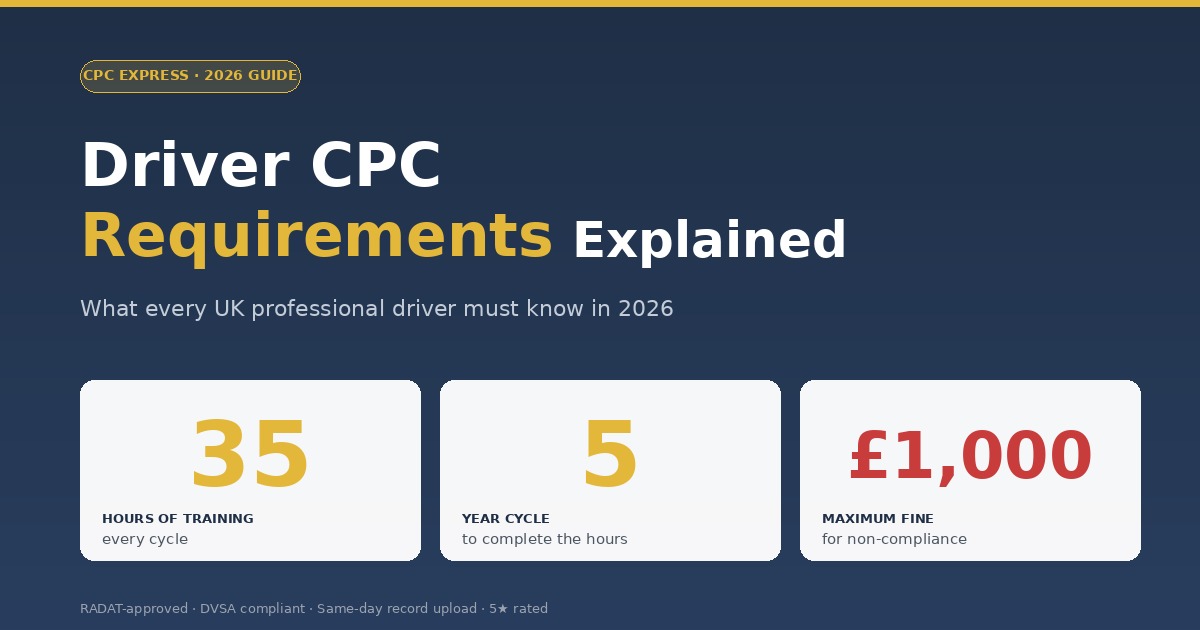
The core Driver CPC requirements are simple: complete 35 hours of approved training every 5 years with a DVSA-registered provider. Without it, you cannot legally drive an HGV, lorry, bus or coach professionally in the UK — and fines reach £1,000 for non-compliance.
Understanding the Driver CPC requirements is the first step to staying legally on the road as a professional driver in the UK. Whether you're a long-distance haulier, a school bus driver, or a delivery driver running tippers, the same legal framework applies — and the consequences for getting it wrong are real.
This guide breaks down everything you need to know in plain English: who needs CPC, what training counts, when you have to renew, what happens if you miss a deadline, and how the 2024 reform changed the rules. Everything below reflects DVSA rules as of April 2026.
Who Has to Meet the Driver CPC Requirements?
Most drivers operating an HGV, lorry, bus or coach professionally must meet the Driver CPC requirements. Specifically, the rules apply if you drive:
- Vehicles requiring a category C licence (HGVs, rigid lorries over 3.5 tonnes)
- Vehicles requiring a category C+E licence (articulated lorries with trailer)
- Vehicles requiring a category D licence (buses with 9+ passenger seats)
- Vehicles requiring a category D+E licence (buses with trailer)
If you drive any of the above as the main part of your job, the 35-hour Driver CPC requirements apply. There are some exemptions — covered later in this guide.
The Core Rule: 35 Hours Every 5 Years
The fundamental rule is 35 hours of approved periodic training within each 5-year cycle. This applies to all qualified drivers — there is no exemption based on years of experience, employer size, or vehicle weight (within the categories above).
What Counts as Approved Training?
Approved training must be delivered by a DVSA-registered provider operating under an approved consortium. Each course is assigned a unique reference, and your hours upload to the GOV.UK Driver CPC system. CPC Express delivers under the NLTC consortium (AC00591) — meaning every course we run counts toward your 35 hours.
How the 5-Year Cycle Works
Your 5-year cycle starts the day your previous Driver Qualification Card (DQC) was issued. To stay compliant, all 35 hours must be uploaded to your record before your DQC expires.
You can spread these hours however suits you — five 7-hour days, ten 3.5-hour evenings, or a mix. Read our guide on splitting Driver CPC training across the 5 years for sample schedules.
National vs International CPC: What Changed
Since the 2024 CPC reform on 3 December 2024, UK Driver CPC split into two qualifications:
- National Driver CPC: 35 hours every 5 years, sessions can be 3.5 or 7 hours, valid for UK driving only
- International Driver CPC: 35 hours every 5 years, sessions must be 7 hours only, valid in UK and EU
The National route gives UK-only drivers more flexibility — perfect for those balancing training around shifts. The International route remains for anyone driving commercially into Europe. For full details, read our guide to which Driver CPC you need.
Compliance Checklist for Qualified Drivers
Stay ahead of compliance with this annual checklist:
- Check your DQC expiry date — it's printed on your card
- Log in to GOV.UK at least once a year to verify your hours are uploaded correctly
- Plan your 35 hours across the 5-year cycle — don't leave it until year 4
- Keep your booking confirmations as proof of attendance
- Verify the provider is on a registered consortium before booking
- Update your details on GOV.UK if you move address
For step-by-step instructions on checking your record, read our guide on how to check your CPC training records.
Exemptions: When You Don't Need CPC
Not every commercial driver needs Driver CPC. Common exemptions include:
- Vehicles with a maximum speed of 45 km/h or less
- Vehicles used by the armed forces, police, fire service or ambulance service
- Vehicles undergoing road tests for technical development or repair
- New vehicles or those that haven't been put into service yet
- Vehicles used in states of emergency or rescue missions
- Drivers undergoing lessons for a vocational licence
- Vehicles carrying materials or equipment used by the driver in the course of their work, where driving is not the main activity
The last point catches many people out. Driving must not be your main activity for that exemption to apply. If your job involves regular professional driving, you almost certainly need CPC — even if your job title is "engineer" or "delivery person".
💡 Not sure if you're exempt? The exemptions depend on how the vehicle is used, not just what type it is. The official GOV.UK Driver CPC training guidance lists every exemption — but if in doubt, assume you need it. The fines are heavy if you assume wrong.
Penalties for Non-Compliance
The DVSA actively enforces compliance. Penalties include:
- Fixed penalty notice: up to £1,000 for driving professionally without valid CPC
- Roadside prohibition: you may be ordered to stop driving immediately
- Operator licence risk: your employer can face enforcement action from the Traffic Commissioner
- Lost earnings: the bigger hit usually comes from missed shifts and cancelled work
- Reputation damage: repeated non-compliance raises serious questions during O-licence reviews
If your DQC has already expired, read what happens if your Driver CPC expires for the fastest route back to compliance.
How Online Training Helps
Most drivers in 2026 prefer online Driver CPC training. The rules explicitly allow live, instructor-led online courses delivered via Zoom or similar platforms — provided the provider is approved by DVSA.
Online training meets every compliance standard while saving you:
- Travel time — no commute to a training centre
- Cost — no fuel, hotels or time off the road
- Flexibility — pick evening or weekend sessions that fit your shift pattern
You'll need a stable internet connection, a webcam (DVSA requires you stay on camera), and a quiet space. That's it.
Frequently Asked Questions
How many hours of training are required?
You must complete 35 hours of approved periodic training every 5 years. This applies whether you hold a National or International Driver CPC.
Do I need Driver CPC if I drive both lorries and buses?
You only need to complete one set of 35 hours every 5 years to keep CPC valid for both vehicle types. You don't have to do separate cycles for HGV and PSV.
What happens if I miss the deadline?
You cannot legally drive professionally until you complete the missing hours. There is no grace period. You can be fined up to £1,000 if caught driving with expired CPC. The fix is straightforward — book and complete the outstanding hours, and DVSA will issue a new DQC.
How do I check my current CPC hours?
Use the official GOV.UK Driver CPC training records service. Log in with your driving licence number — you'll see exactly how many hours you've completed in your current cycle.
Are the rules different for new drivers?
Yes. New professional drivers must first pass the Initial Driver CPC qualification (theory test, case studies, practical demonstration). Once qualified, they enter the standard 5-year periodic training cycle covered in this guide.
How much does it cost?
Total cost depends on the provider. CPC Express courses start at £16.99 for a 3.5-hour National session and £29.99 for a 7-hour course. Total spend over the 5-year cycle is typically £150–£300 depending on session mix.
Stay ahead of your Driver CPC requirements
Book your next training session in minutes. From £16.99 per 3.5-hour course. DVSA-approved with same-day record upload.
View Available Courses →