
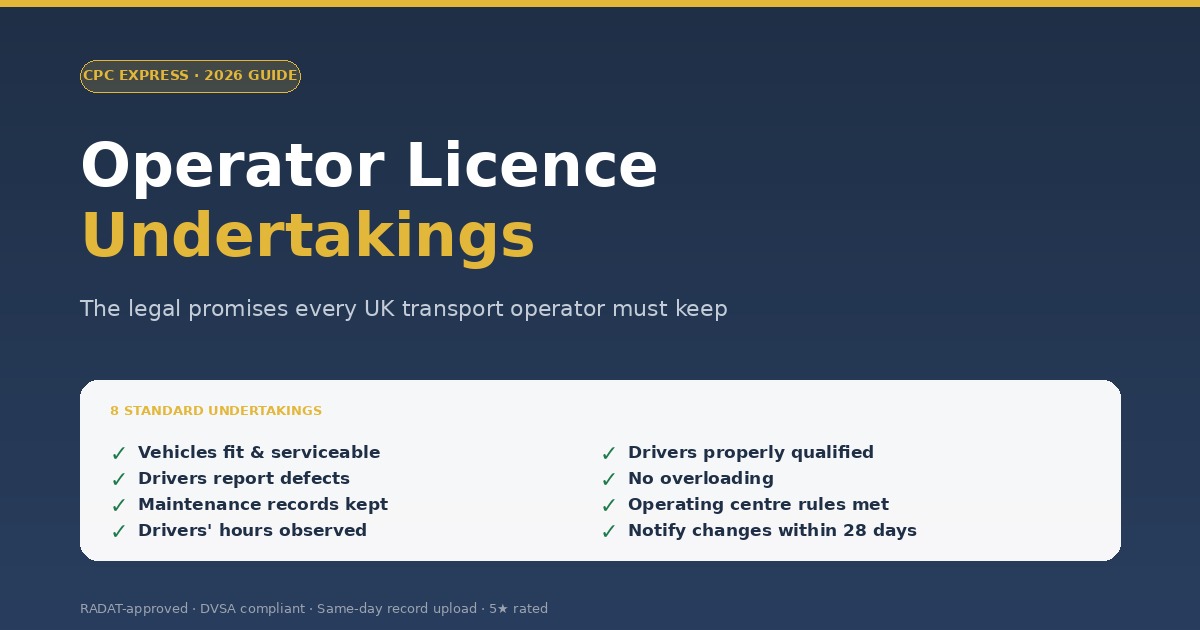
Operator licence undertakings are the legal promises you make to the Traffic Commissioner when granted a goods vehicle Operator's Licence. They cover safe vehicles, qualified drivers (including valid Driver CPC), drivers' hours compliance, financial standing, and good business conduct. Breaching them can lead to Public Inquiry, restrictions, or licence revocation.
Most UK fleet operators sign up to operator licence undertakings without fully understanding what they're committing to. The undertakings aren't fine print — they're enforceable legal obligations that the Traffic Commissioner takes seriously. Failing to meet them is one of the fastest ways to lose your O-licence.
This guide explains each undertaking in plain English, what it means in day-to-day operations, and how to build the systems that keep you compliant year after year.
What Are Operator Licence Undertakings?
When you apply for a goods vehicle Operator's Licence (O-licence), the Traffic Commissioner grants it on the condition that you commit to a set of legally binding promises. These are called operator licence undertakings.
They appear on your licence document and you sign to confirm you'll meet them. Once you're operating, the Traffic Commissioner and DVSA can audit you against each one. Failure to keep your undertakings is the basis of nearly every Public Inquiry referral in UK transport.
For a wider overview of how undertakings fit into the broader compliance picture — including the DVSA's OCRS traffic light system and the five compliance pillars — read our guide on Operator's Licence compliance.
Has the Traffic Commissioner asked you to complete OLAT? Operator Licence Awareness Training is one of the most common undertakings added on the grant of a licence or after a Public Inquiry. Book a live online OLAT session and receive a named certificate as your evidence.
The Standard Operator Licence Undertakings
Every UK goods vehicle O-licence carries the same set of standard undertakings. Some operators also have additional ones (such as specific operating centre conditions). The core list:
- Vehicles fit and serviceable Vehicles will be kept in a fit and serviceable condition at all times. This means scheduled safety inspections, defect reports acted on, and no unsafe vehicles on the road.
- Drivers report defects Drivers must report any defect that could prevent the safe operation of the vehicle. Operators must keep records of all reports — including "nil defect" reports.
- Records of safety inspections Records of all driver-reported defects, safety inspections, routine maintenance, and repairs must be kept for at least 15 months and made available on request.
- Drivers' hours and tachograph compliance Operators will observe drivers' hours rules and ensure tachographs are used correctly. Infringements must be addressed proactively, not ignored.
- Drivers properly qualified All drivers must hold valid driving licences AND valid Driver CPC. Verifying this before every shift is the operator's responsibility.
- No overloading Vehicles will not be overloaded. Weighbridge checks, load planning, and weight tickets matter — overloading is one of DVSA's top roadside enforcement targets.
- Operating centre commitments Vehicles will only be parked at authorised operating centres. Centres must be of sufficient size and not cause environmental nuisance.
- Financial standing maintained Operators must hold sufficient available capital at all times — the threshold is set annually by the Traffic Commissioner. Loss of financial standing can trigger licence revocation, regardless of operational compliance.
- Notify changes to the Traffic Commissioner Material changes — such as a change of Transport Manager, address, or company structure — must be reported within 28 days.
What Must Vehicle Operators Provide for Their Drivers?
Under the undertakings, the operator, not the driver, is responsible for giving drivers what they need to work legally:
- Roadworthy vehicles, with a working system for daily walkaround checks and for reporting and fixing defects.
- Instruction and training on drivers' hours, tachograph use and the walkaround check, with records kept.
- Working tachographs and driver cards, plus regular downloads and analysis, with any infringements raised with the driver.
- Schedules that allow legal driving, so drivers can meet drivers' hours and Working Time rules without pressure to break them.
- Licence and Driver CPC checks, so every driver holds the right entitlement and a valid Driver Qualification Card.
Why Operator Licence Undertakings Matter
The Traffic Commissioner uses your undertakings as the benchmark for every compliance decision. If you're called to a Public Inquiry, the question they'll ask is: "Have you met your undertakings?"
Common scenarios where operators fall short:
- Driver CPC lapses going unnoticed — the operator didn't have a system to track DQC expiry dates
- Maintenance records missing — vehicles were serviced but reports weren't kept properly
- Tachograph infringements unaddressed — drivers exceeded hours but the operator didn't act
- Operating centre changes not declared — vehicles being parked at undeclared locations
- Financial standing eroded silently — capital reserves dropped below the threshold during a cash-flow squeeze, but no review was triggered
- Transport Manager not exercising real control — a "name on paper" doesn't satisfy the undertaking
💡 The Driver CPC undertaking is the most enforceable one. DVSA can verify CPC status instantly at the roadside. A driver caught without valid CPC is a clear, documentable breach — usually leading to follow-up action against the operator and a drop in your OCRS band.
How to Meet Your Operator Licence Undertakings Day-to-Day
The operators who meet their undertakings consistently follow a similar five-step system:
1. Build a driver compliance register
For every driver: licence number, DQC expiry, CPC hours completed, last licence check date. Review monthly. This single spreadsheet prevents 90% of CPC-related undertaking failures.
2. Schedule preventive maintenance
Set inspection dates for every vehicle on a calendar. Use a defect-reporting book that drivers complete daily. Keep all records for 15+ months.
3. Use tachograph analysis software
Manual review of tachograph data is impossible at scale. Modern compliance software flags infringements automatically and prompts driver conversations.
4. Train your Transport Manager — and your operations staff
The Transport Manager is your primary defence at any Public Inquiry. They must hold a valid CPC qualification and demonstrate they exercise "continuous and effective control" — not just sign documents occasionally. Wider operations staff (traffic office, planners, compliance officers, supervisors) should complete Operator Licence Awareness Training (OLAT) so the whole team understands the rules they're enforcing day-to-day.
5. Run mock audits annually
Pretend DVSA is auditing you tomorrow. Can you produce 15 months of safety inspection records? Can you prove every driver's CPC is current? Can you evidence your financial standing? If yes, your undertakings are intact.
Public Inquiry is not a slap on the wrist. Operators called before the Traffic Commissioner can lose their licence on the day. Disqualification orders can prevent directors from holding any future O-licence — sometimes for years. Compliance is far cheaper than enforcement.
The Driver CPC Connection to Operator Licence Undertakings
Among all the undertakings, Driver CPC compliance is the one most often raised at Public Inquiries — because it's the easiest for DVSA to verify and the easiest for operators to monitor.
Best practice for operators:
- Verify CPC status before every shift — particularly for agency or new drivers
- Use a single approved provider — CPC Express, the RADAT-approved Driver CPC training provider operating under NLTC consortium AC00591, delivers with same-day GOV.UK uploads
- Keep training records on file — booking confirmations, attendance certificates, GOV.UK screenshots
- Train multiple drivers in a batch — many providers offer fleet discounts for group bookings
- Train operations staff alongside drivers — book your Transport Manager, supervisors and traffic office team onto OLAT so compliance becomes an organisational habit, not a one-person responsibility
For more detail on what every operator needs to verify, read our Driver CPC requirements guide.
What Happens If You Breach Operator Licence Undertakings?
The Traffic Commissioner has a graduated response:
- Letter or warning — for minor or first-time breaches
- Public Inquiry — for serious or repeated failures
- Restrictions — fewer authorised vehicles, geographic limits
- Suspension — temporary loss of operating rights
- Revocation — full loss of the O-licence
- Disqualification — directors barred from future operator status
Most operators who lose their licences had every chance to fix things before enforcement. The Traffic Commissioner's published Public Inquiry decisions repeatedly show the same pattern: warnings ignored, then formal action.
Frequently Asked Questions
Where can I find my operator licence undertakings?
They appear on your O-licence document. The Office of the Traffic Commissioner also publishes the standard list on GOV.UK. If you can't find your copy, request one from the Traffic Commissioner's office.
Can operator licence undertakings change after my licence is granted?
The standard undertakings rarely change, but specific conditions on your licence (such as operating centre limits) can be modified by the Traffic Commissioner — usually after a Public Inquiry or with operator consent.
Do small operators have the same undertakings as large fleets?
Yes. The standard undertakings apply equally regardless of fleet size. A 1-vehicle operator faces the same obligations as a 500-vehicle operator.
What training do operations and office staff need?
Non-driving operations staff — Transport Managers, traffic office, planners, supervisors, compliance officers — should complete Operator Licence Awareness Training (OLAT). It's a 7-hour course covering the legislation, undertakings, and compliance obligations that govern UK transport operations, and counts as 7 hours toward Driver CPC for any attendee who also holds a vocational licence. If you're not certain whether it applies to you, read what OLAT is and who needs it.
What's the most common breach of operator licence undertakings?
Drivers without valid Driver CPC, followed by missed safety inspections and tachograph infringements. All three are easy to track if you have a compliance system.
Can I appeal a Traffic Commissioner decision?
Yes — appeals can be made to the Upper Tribunal (Administrative Appeals Chamber). However, prevention is far cheaper than appeal. Maintain your undertakings from day one.
How do I evidence compliance with my undertakings?
Keep dated records: maintenance schedules, defect reports, tachograph downloads, driver training records, GOV.UK CPC screenshots, and current financial standing evidence. Retain for at least 15 months. Be ready to produce them within 24 hours of any DVSA request.
How do undertaking breaches affect my OCRS score?
Most breaches that result in prohibitions, fixed penalties, or convictions feed directly into your OCRS score across a rolling 3-year period — potentially dropping you from Green to Amber, or Amber to Red. Red operators face frequent roadside stops and depot inspections. Read more in our Operator's Licence compliance guide.
Lock in your fleet's compliance
Same-day DVSA uploads, fleet booking discounts, full RADAT and NLTC approval. CPC Express helps operators meet their undertakings every shift.